
Catoosa County Arrest Warrants Explained
Catoosa County's own Magistrate materials explain the flow. Criminal warrants issue through the Magistrate's Office, then pass to the Sheriff for service. The county court index agrees, placing applications for summonses, arrest warrants, and search warrants in Magistrate Court. Catoosa State Court adds a second layer. Its official description covers hearings on applications and issuance of arrest and search warrants, along with holdings of inquiry. So it would overstate things to say every Catoosa County warrant starts in one office. For any single case, the court named on the record is the controlling source. Neither court publishes a public list of named subjects. Go to the issuing court for the case at hand.
Catoosa County Warrant Application Path
The Catoosa County Magistrate Court is the place to learn how criminal-warrant applications work. A judge may hold a pre-warrant hearing. Witnesses can testify there, including the person the application targets. That person has Miranda rights, may have counsel, and should know that statements can be used and that the hearing is recorded. Probable cause means enough facts to support a reasonable basis for the requested process. It settles the warrant question, not the whole criminal case. A signed arrest warrant directs custody. A summons only orders an appearance. Court personnel can explain filing and record access, but they cannot replace counsel on a personal case. Note: a warrant application is not the same as an issued, current Catoosa County arrest warrant.
Inside a Catoosa County Arrest Warrant
A real Catoosa County warrant record stays with the offices that hold it. Those files can carry private identifiers and live allegations. Release depends on the record. A sealed file, a pending investigation, a juvenile matter, or redaction required under Georgia law can each limit what a requester sees.
| Issuing court | Identifies the judge or court that controls the process. |
|---|---|
| Process type | Distinguishes an arrest warrant from a summons, search warrant, or bench warrant. |
| Issue date | Shows when the judicial process was signed, not whether it remains current today. |
| Alleged offense | States the charge or statute description without proving guilt. |
| Jurisdiction | Connects the record to the proper county, city, or court. |
| Status or validation | May show a later update only when the custodian releases and defines it. |
| Service instruction | Routes law enforcement or the affected person to the next official step. |
Catoosa County publishes no public status legend or local warrant-number format. Ask the records staff what each released field means.
Catoosa County Warrant Record Validation
The Sheriff Records Division page explains that its terminal agency coordinator enters warrants into GCIC and NCIC and keeps validations current. GCIC is the Georgia Crime Information Center system. NCIC is the national law enforcement information system. That work keeps agencies in sync. Neither system gives the public a Catoosa County arrest warrant search, though. Access runs through sworn channels, not open lookup. Validated does not mean served. An old copy proves nothing about today. Terms like recalled, quashed, bonded, transferred, or released each mark a different event. No local legend defines them, so current status must come from the issuing court or the sheriff office holding the record. Ask when the warrant was checked and which agency gave the answer. The Sheriff's Records page lays out that internal recordkeeping role behind warrant verification.
Catoosa County offers an agency-specific check this way, not public access to GCIC or NCIC.
Serving Arrest Warrants in Catoosa County
After issuance, service falls to law enforcement. The Catoosa County Sheriff Court Services page says the office serves criminal warrants along with civil papers. A city officer or another agency can take part within its own lawful role. No office promises where or when a particular warrant will be served. Custody can follow a planned arrest, a routine encounter, or a voluntary surrender arranged with advice. Booking and bond come next in Catoosa County. A first appearance follows on the judge's schedule and at the judge's discretion. Even after one bond posts, a hold in another matter can keep a person in custody. The Court Services page shows the sheriff's role in serving arrest warrants and supporting the courthouse.
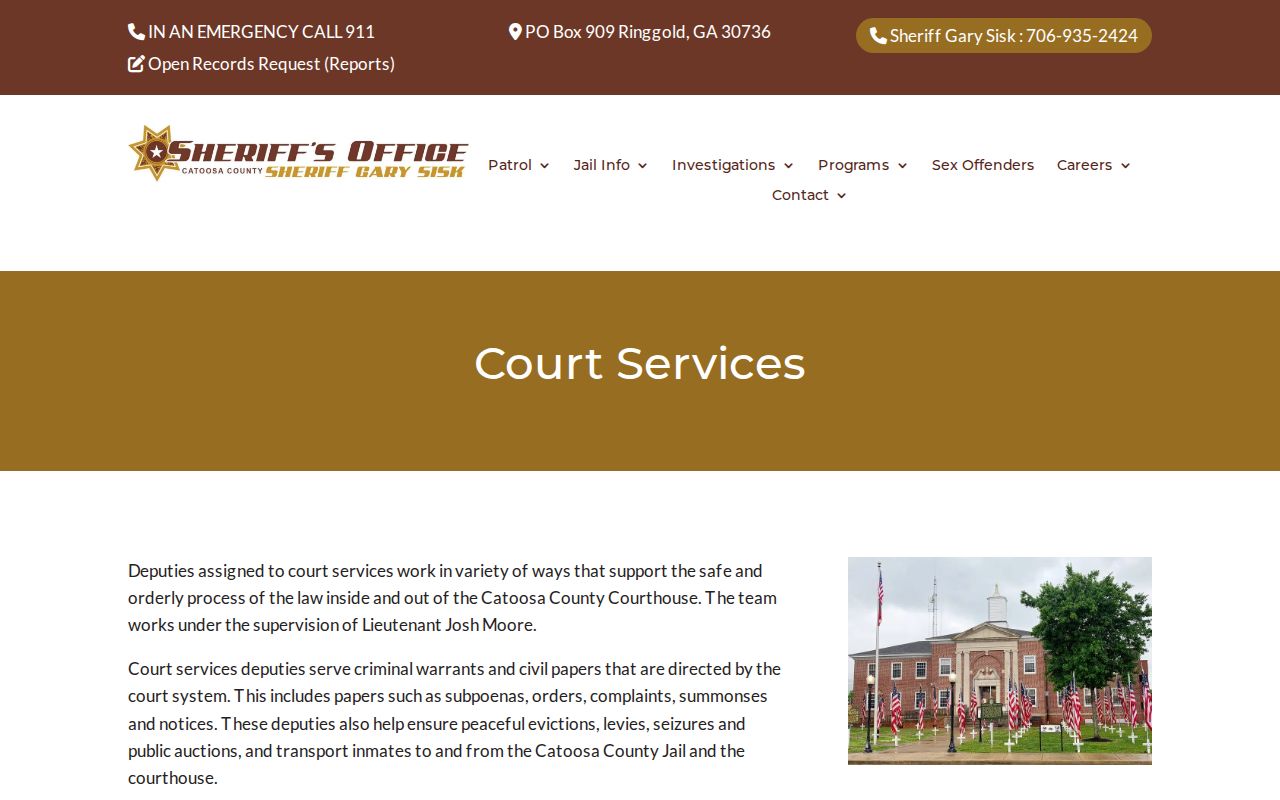
Catoosa County separates warrant service from record access.
Catoosa County Bad-Check Warrant Process
Catoosa County's Magistrate paperwork spells out one deposit-account fraud example in unusual detail. The check must carry present consideration for goods or services. It must reach the bank within 30 days. Next comes a 10-day certified letter, sent within 90 days. Once the green card returns, the applicant waits ten full days. Then the card and the check go together to the Magistrate Office. Stop-payment checks get no warrant under that route at all. That timeline is one worked example, not the rule for every Catoosa County arrest warrant. It simply shows facts and documents moving to a judicial office before process issues. Forms and rules do change. Confirm current Magistrate Court practice at 706-935-3114, and get legal advice. Treat this summary as orientation, never as a filing instruction.
Comparing Arrest, Summons, and Bench Warrants
Catoosa County courts treat these three papers as different tools. An arrest warrant authorizes custody after a judge reviews the matter. A summons only directs a person to appear. A bench warrant can follow a missed duty inside an open case. Read the record's title, not a loose tag like "wanted."
| Feature | Arrest Warrant | Summons | Bench Warrant |
|---|---|---|---|
| Main command | Take the named person into custody | Appear as directed | Authorize custody after a missed obligation |
| Common basis | Probable cause of an alleged offense | Court appearance without initial custody | FTA, contempt, or other missed court duty |
| Response | Confirm and plan surrender or bond with counsel | Appear by the stated date | Contact issuing court about recall or appearance |
Ignoring a summons can bring further court action. But it is not a warrant until the court acts. The companion Catoosa County bench warrant search covers local municipal failure-to-appear rules.
Catoosa County First Appearance
Catoosa County holds first appearances by video conference. The public may watch from the Magistrate Courtroom. Two Sheriff pages even list different times, one saying 1:00 p.m. on weekdays and another saying mostly 1:30 p.m. Confirm the current schedule before you go, since neither time alone is safe to rely on. A judge may set bond and conditions at the hearing. The Sheriff splits bonds into cash, property, and transfer types. Its bond-fee page lists a $20 state fee in exact U.S. currency, separate from the bond amount. Cash bonds demand exact currency. Property and transfer bonds need their own documents. Jail employees cannot recommend a bond company or discuss a company's service fee. The Sheriff's first-appearance page explains the video format and the public viewing that follow a Catoosa County arrest warrant being served.
Confirm the live schedule because the two posted Sheriff descriptions do not match.
If There’s an Arrest Warrant for You
Start with direct confirmation. Catoosa County's Sheriff posts no public arrest-warrant roster. Georgia guidance says to contact the sheriff in the county that issued the warrant, with a first and last name plus date of birth in hand. Some offices answer by phone. Others want a visit in person. Call Catoosa Sheriff at 706-935-2424, or email Records at catoosarecords@catoosacountyga.gov.
- Identify the likely issuing court and confirm the official contact channel.
- Ask what personal details and identification the office requires before sending them.
- Consult a lawyer about voluntary surrender, bond, and any motion to recall or quash.
- Arrange the lawful response the issuing court and counsel identify.
- Check the court record again after action is taken.
Important: Georgia warns that an in-person warrant inquiry can lead to immediate custody, so seek legal advice and prepare before appearing.
No step guarantees release in Catoosa County. Other holds or conditions may apply, and only the court and jail can state the current result.
Catoosa County Arrest Warrant Requests
An open-records request fits policies, blank forms, and aggregate counts. It is not a same-day warrant check. Catoosa County handles requests through its GovQA system, which spans county government, the sheriff, and the courts. Setting up takes an account. The system covers intake, tracking, follow-up, and email updates. The Sheriff route runs through "Open Records Request (Reports)," then "Submit a Request," then the Sheriff's Office Records tab. Under Georgia Open Records Act guidance, an agency generally responds within three business days or gives a timetable, a cost estimate, or its legal basis for withholding. Name your date range. Say which existing record category you want. List the electronic format you prefer. Note any redactions you will accept. Pending investigations, juvenile material, and protected personal details may be withheld or redacted anyway. Ask about warrant entry, service, recall, or public-inquiry policy, or request aggregate counts if the Catoosa County office keeps them. A denial proves nothing about a warrant either way. For your own current status, verify with the Catoosa County court or sheriff first.